
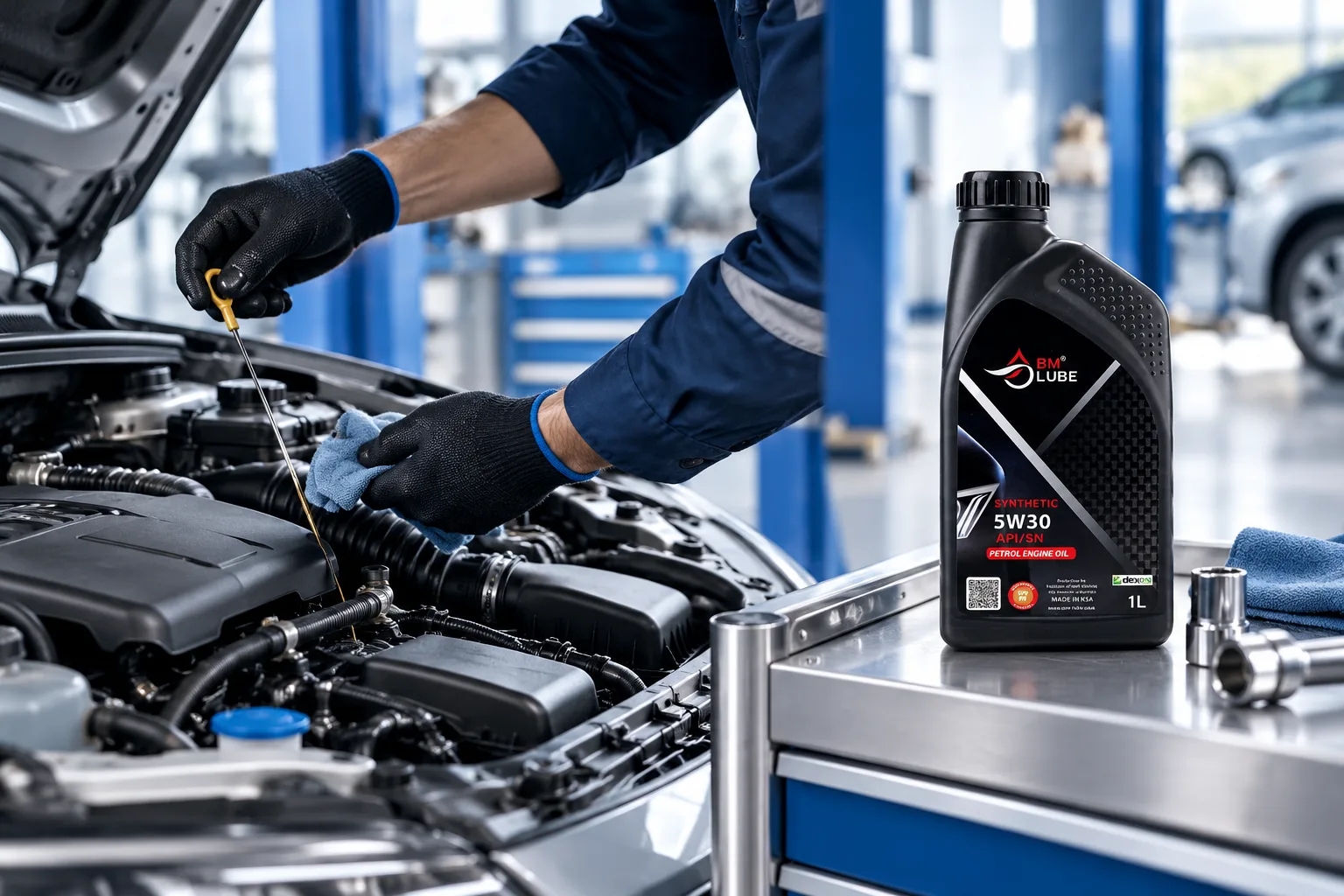
Start with the vehicle manufacturer
Find the required SAE grade, performance category and any manufacturer-specific approval in the owner’s handbook. Some vehicles allow alternatives for particular climates or operating conditions, but that does not make every oil suitable for every engine.
Understand viscosity numbers
In a grade such as 5W-30, the W part relates to low-temperature performance, while the other number identifies a viscosity grade at operating temperature under SAE testing. These numbers do not describe overall quality or the oil-change interval.
Distinguish a specification from an approval
A designation such as API SN describes a stated performance category. A vehicle manufacturer approval is a separate claim that requires explicit documentation for that exact product. A logo or similar product name is not enough to establish an approval.
Consider how the vehicle is used
Stop-start traffic, dust and heavy loads may fall under severe-service conditions in your vehicle handbook. Follow the appropriate maintenance schedule rather than extending intervals simply because an oil is synthetic.
Ask with the right information
Have the vehicle model, year, engine type and required specification ready. Share these details with our team on WhatsApp to discuss available BM LUBE options without assuming compatibility in advance.